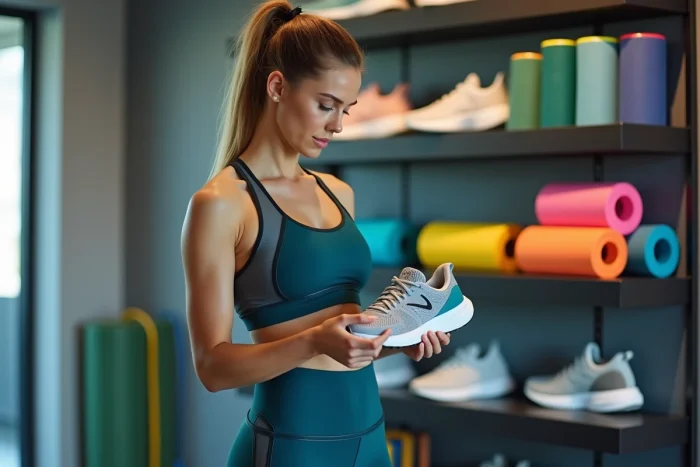
Women’s sports equipment includes all clothing, shoes, accessories, and devices designed or adapted to the morphology and biomechanical constraints of women. The choice of this equipment is based on specific technical criteria, which vary according to the discipline practiced, the level of intensity, and the context of use.
Technical fibers and thermal management: how material affects effort
The first selection filter for women’s sportswear is neither the cut nor the color, but the textile composition. Synthetic fibers like polyester or polyamide wick away sweat much faster than cotton, which absorbs moisture and clings to the skin.
So-called seamless fabrics (without visible seams) reduce friction in contact areas, particularly under the arms and inside the thighs. For high-intensity activities like HIIT or running, mesh inserts placed in strategic locations (back, armpits) enhance ventilation without compromising support.
A compressive legging, for example, is not only designed to shape the silhouette. Light compression promotes venous return and reduces muscle vibrations, which decreases perceived fatigue during long sessions. This technical benefit justifies choosing a fitted legging over a loose bottom, even for yoga or Pilates.
To find all the equipment on Carnet de Sportive, simply filter by discipline and practice level to identify materials suitable for each use.
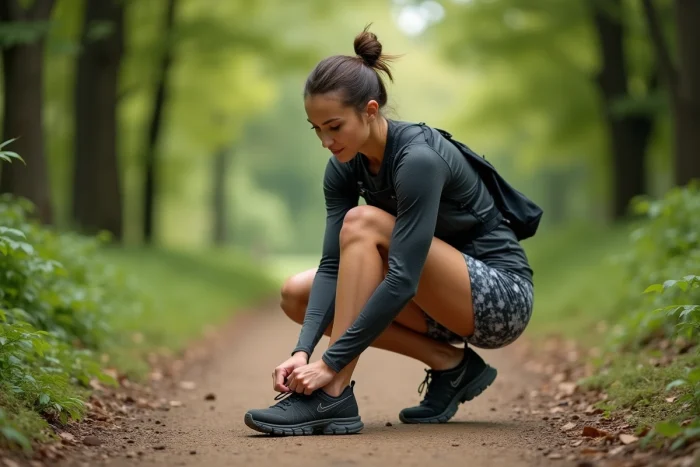
Women’s sports bra: adapting support to impact level
The sports bra is probably the most underestimated and poorly chosen piece of equipment. Its role goes beyond simple comfort: it protects the Cooper ligament, a connective tissue that, once stretched, does not return to its original shape.
The choice of bra directly depends on the impact level of the activity. This criterion takes precedence over cup size or aesthetic preference.
- Low impact (yoga, stretching, walking): a soft, wire-free bra with stretchy fabric and thin straps is sufficient to support the bust without excessive constraint.
- Moderate impact (cycling, weightlifting, hiking): a racerback model with a wide underband offers better anchorage while remaining comfortable over time.
- High impact (running, HIIT, team sports): a bra with separate cups, adjustable straps, and a back closure limits vertical and lateral movements of the bust, even beyond cup C.
The basic rule for checking fit: the underband should remain horizontal at the back, without riding up. If it rides up, the support is insufficient.
Women’s heart rate monitor: weight, case size, and wrist accuracy
Sports watches have long been designed on male templates, with wide cases and bands unsuitable for slender wrists. The offering has changed: recent models feature more compact cases and a weight of less than 60 g, the threshold beyond which continuous wear comfort deteriorates.
Reduced weight is not just a matter of comfort. A case that is too heavy or wide slips on the wrist during exertion, which distorts the optical measurement of heart rate. A lightweight and well-fitted model improves the reliability of the heart rate sensor, particularly during rapid movements (running, floor exercises).
Functions to prioritize based on practice
For cardio in the gym or at home, real-time heart rate tracking and calorie expenditure estimation are sufficient. For outdoor running, integrated GPS and barometric altimeter become useful. Sleep tracking and menstrual cycle tracking functions, present on several recent watches, provide additional data to adjust training loads.
A watch worn 24/7 must also be lightweight for daily use, not just during workouts. This criterion eliminates models designed for diving or ultra trail, which are too bulky for mixed sport/daily life use.
Home fitness equipment: going beyond the mat and dumbbells
Home sports equipment is no longer limited to a mat and a pair of dumbbells. Practitioners who want to progress should diversify mechanical stimuli to engage the entire body.
The rowing machine, for example, engages about 85% of muscle mass in a single movement. It combines cardio work and strength training, with very low joint impact compared to running. For women returning to sports or with knee vulnerabilities, the rowing machine offers a rare compromise between intensity and joint preservation.
- Variable resistance elastic bands allow strength training without overloading the joints, with minimal space requirements.
- A moderate-weight kettlebell (between 8 and 12 kg depending on the level) develops trunk power and stability better than a traditional dumbbell.
- The Swiss ball, often relegated to the status of a gadget, remains an effective tool for deep core stability and postural rehabilitation.
The goal always takes precedence over the budget. Buying an expensive device that ends up unused costs more than investing in three complementary accessories used each week.
The choice of suitable women’s sports equipment relies on understanding three technical parameters: the material of the textiles, the level of support required by the activity, and the ergonomics of the accessories in relation to morphology. Well-chosen equipment does not compensate for training, but poorly chosen equipment hinders it.