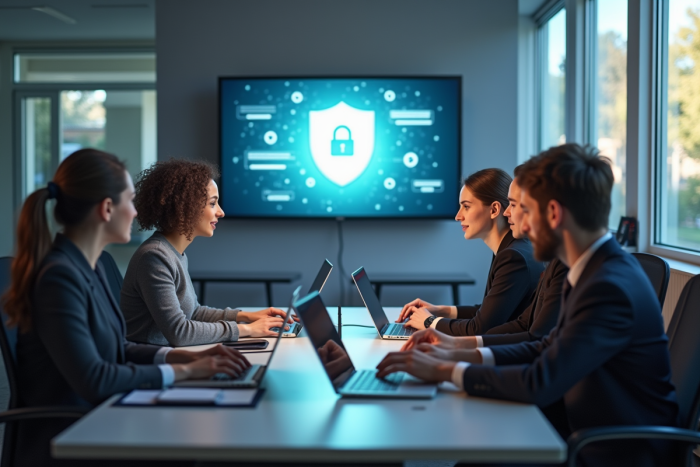
A confidential file shared by mistake, a forgotten password that opens the door to hackers, a distracted employee clicking on a dubious link: sometimes it only takes a mundane action to trigger a data leak or a major crisis within the company. As digital tools invade our professional lives, messaging remains both a performance ally and a blind spot for security.
Professional Messaging: Why Digital Security is More Fundamental Than Ever
Since email has become established in offices, it has become the hub of strategic exchanges, personal data, and confidential documents. This is not trivial: every message that passes through attracts the attention of cybercriminals seeking opportunities. According to PWC France, a cyberattack carried out via email costs the affected company an average of over one million dollars. In practice, professional messaging often serves as a preferred entry point for hackers.
The texts of the GDPR emphasize the confidentiality of exchanged information. Email security is no longer just about the strength of a password; it also relies on encryption, multi-factor authentication, and appropriate protection tools. ANSSI and CNIL closely monitor these practices, requiring companies to remain vigilant, whether on their internal servers or in the cloud. At the slightest vulnerability, it is not only internal data that is at stake, but also the trust of clients and partners.
The rise of cloud computing and collaborative platforms like Microsoft 365 or Outlook is disrupting the daily operations of companies. The benefits of secure email storage come with new questions, particularly regarding environmental impact. Just take a closer look:
- Every email sent or received has a real energy cost,
- The servers required weigh heavily on the company’s carbon footprint,
- Attachments saturate bandwidth and complicate management.
Rethinking the security of communications also means questioning habits and tools.
To resolve connectivity issues while preserving data protection, the solution webmail IA85 proposes an approach that combines ease of access with security requirements. But nothing replaces the method: the security of a corporate messaging system must be maintained daily, through training, the adoption of reliable reflexes, and regular updates.

Major Risks and Best Practices to Protect Your Electronic Communications in the Workplace
Phishing and ransomware attacks still primarily target professional messaging. The numbers are indisputable: 93% of security breaches originate from a compromised email. Small and medium-sized enterprises, sometimes less equipped to handle them, account for nearly half of the attempts. A malicious message can be enough to pave the way for financial losses, production stoppages, or the disclosure of sensitive data.
Encryption of messages prevents any exploitation of their content in case of interception. Activating MFA (multi-factor authentication) remains the most robust defense against identity theft. As for the password, it must remain strong, unique, and entrusted to a secure manager, a fact that is too often overlooked.
Training teams on email security is becoming essential, as attacks evolve rapidly. Regular awareness campaigns, shared vigilance, and support from AI-driven protection solutions provide an edge against attacks.
Here are the essential measures to integrate into the daily routine of an organization concerned about its electronic exchanges:
- Encrypt all sensitive exchanges without exception.
- Protect each account by activating MFA.
- Regularly change passwords and prioritize their complexity.
- Keep security tools updated, frequently back up data.
- Disseminate a concrete and adapted IT charter among teams.
Respecting the internal regulations and informing each employee about managing their access to messaging falls within the legal framework, under the attentive gaze of CNIL. With every departure, the company must assist in closing the account and rigorously separate professional messages from personal exchanges, which are subject to the confidentiality of correspondence.
Digital security is not automatic; it is earned through rigor, adaptation, and anticipation. In this game of cat and mouse, every human or technological link counts. And tomorrow, who can say whether the next email received will be the one that puts the entire organization to the test?