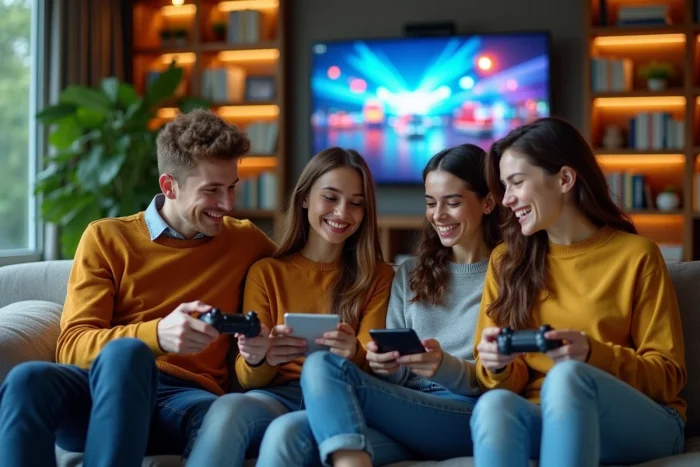
In 2023, the profitability of streaming platforms surpasses that of traditional television in several key markets. Yet, the offer seems saturated. Hollywood, on the other hand, is navigating by sight: writers’ strikes, a fragmented audience, interactive experiments, and a constantly readjusted release schedule.
The growth in the number of digital subscriptions is slowing down. At the same time, advertising budgets are migrating en masse to social media, disrupting the rules of monetization. The lines are blurring between music, video games, and video on demand: players must reinvent their model to remain competitive against a competition that leaves no room for stagnation.
What upheavals await the media and entertainment sector in 2024?
Artificial intelligence is no longer just making its way into the media and entertainment landscape: it is becoming its beating heart. Publishers and creators are seizing it, from content recommendation to advanced personalization of the user experience. In the French market, audience fragmentation is increasing. Platforms must attract demanding users and constantly adjust to new features that change the game.
The relationship between brands, media, and consumers is transforming. Users want seamless, interactive experiences, with no barriers between formats. This quest for continuity is accompanied by a rise in immersive, dynamic content, where interaction becomes the norm. Professionals are observing an acceleration of hybridization: audio, video, text, social communities, everything converges to meet multiple uses.
Here are the dynamics shaping this rapidly evolving sector:
- Trends: explosion of generative AI, interactivity, tailor-made content
- Platforms and users: shifting expectations, search for proximity, increased mobility
- New features: smart recommendations, evolving interfaces, gamification
For those who want to anticipate these changes, consulting mediagaga.fr online offers sharp insights into the sector. French players, faced with the globalization of uses, are reworking their strategy to remain relevant in a fast-paced universe.
Streaming, cinema, music, video games: overview of major transformations in the digital age
The media entertainment sector is undergoing a profound transformation, driven by the rise of streaming platforms and the growing power of video games. Access to works has become dematerialized, facilitating the global circulation of content and the emergence of new forms of social exchange. Social networks now bring together communities numbering in the millions. The relationship between creators and the public is being disrupted.
Music is following suit. The Taylor Swift phenomenon is proof of this: a global success driven by the energy of women and millennials, now at the center of strategies. These groups dictate trends, consume discerningly, and influence usage on social media. This new power dynamic requires continuous adaptation of formats and modes of distribution.
These transformations are evident in several fundamental areas:
- Streaming: multiplication of offers, suggestion algorithms, easier access to all types of content
- Video games: enhanced social dimension, immersive experiences, breakthrough of augmented reality
- Cinema: hybrid releases, closer collaborations with digital platforms
The barriers between the worlds of content are falling. Uses are fragmenting, but the connected community leaves its mark: each technical or editorial innovation reshuffles the cards of production, distribution, and consumption of media and entertainment.

Reinventing marketing strategies in the face of the rise of digital and social uses
Digital marketing is undergoing a revolution. The emergence of social media and the rapid evolution of connected audience expectations force marketing specialists to rethink their tactics. Strategies must now align with the fragmentation of uses, shifting cultural references, and the demand for immediacy.
The customer relationship is played out over short timescales, dictated by virality, hyper-personalization, and responsiveness. Each social platform has its own codes, formats, and audience. Companies adjust their methods: they leverage data, segment their audience, and deploy campaigns across multiple channels simultaneously. A marketing director in France from a major group summarizes it this way: the new generation of customers wants authenticity and engagement, not a canned speech.
The drivers of this new generation of marketing are clear:
- Social media: space for interaction, lever for community engagement, permanent testing ground
- Segmentation: messages tailored according to age groups and detected practices
- Personalized communication: custom messaging, in line with the real expectations of the audience
Marketing no longer relies on ready-made recipes. It is rooted in co-creation, conversation, and precise measurement of impact. Media and entertainment brands that manage to capture attention are those that know how to unite, listen, and react in real-time to the weak signals from their community. The real challenge? Creating connections where attention is scarce and valuable. Ignoring this risk means becoming invisible.