AirCover for travelers is neither insurance in the legal sense nor a traditional contractual guarantee. It is a protection program integrated into every Airbnb booking, the scope and activation conditions of which deserve a precise technical reading. Understanding its actual mechanisms allows for anticipating blind spots and knowing when additional coverage is necessary.
AirCover Reporting Deadline: The 72-Hour Trap
The majority of AirCover coverage denials from the traveler’s side are based on exceeding the reporting deadline. The deadline starts from the discovery of the problem, not from the arrival date. This distinction changes everything in several common scenarios.
A latent defect (faulty plumbing, pests, dangerous equipment) may only become apparent after several days of occupancy. The traveler then has 72 hours from the moment of discovery to report the issue via the platform. Without a report within this timeframe, the request for reimbursement or relocation loses its procedural basis.
We recommend systematically documenting any defect as soon as it is discovered: time-stamped photos, messages to the host via Airbnb messaging (never by SMS or untraceable call), and opening a ticket with support. The article detailing the AirCover insurance for Airbnb travelers specifies the steps to follow to build a solid case.
A late report, even accompanied by photographic evidence, will be treated with a margin of appreciation unfavorable to the traveler. Procedural rigor takes precedence over the severity of the problem.

AirCover Reimbursement: Margin of Appreciation and Real Criteria
Reimbursement is not automatically proportional to the price of the stay. This is the most underestimated point of the system. Airbnb evaluates each request based on several intersecting criteria.
- The objective severity of the problem: a heating failure in winter does not weigh the same as a missing secondary piece of equipment.
- The strength of the evidence provided: photos, screenshots of the listing, exchanges with the host via the integrated messaging.
- The proportion of the stay affected: a problem occurring on the last day does not generate the same calculation as a defect noted upon arrival.
- The fact that the traveler leaves or stays in the accommodation: remaining on-site after reporting may be interpreted as a partial acceptance of the situation.
In practice, the platform offers either relocation to a similar accommodation (comparable location and amenities, subject to availability) or a partial or full refund, including service fees. The traveler may also be offered travel credit instead of a refund to the original payment method.
Host Cancellation and Relocation
The conditions have been revised to remove the requirement that cancellation must occur within 30 days prior to arrival. Any cancellation by the host now entitles the traveler to relocation assistance, regardless of the timing. The traveler chooses between travel credit and direct reimbursement.
AirCover Exclusions and Limits of Traveler Coverage
AirCover covers serious issues related to the booking: host cancellation, inability to access the accommodation, accommodation significantly different from the listing, or situations affecting the traveler’s safety. Security assistance operates continuously.
However, AirCover does not replace travel insurance or home insurance. The scopes are distinct and not cumulatively applicable in the same way.
- The traveler’s personal belongings (theft, damage, loss) are not covered by AirCover. Only personal travel insurance can intervene.
- Medical expenses, repatriation, or cancellation for personal reasons fall exclusively under a travel insurance policy taken out by the traveler.
- Minor issues (unstable wifi, noise from neighbors, decoration different from photos) do not constitute a valid reason.
For residents of the European Union, AirCover aligns with local consumer protection regulations but does not replace them. A European traveler retains their legal rights independently of the Airbnb program.
AirCover Traveler vs. Traditional Travel Insurance: What Additional Coverage to Subscribe
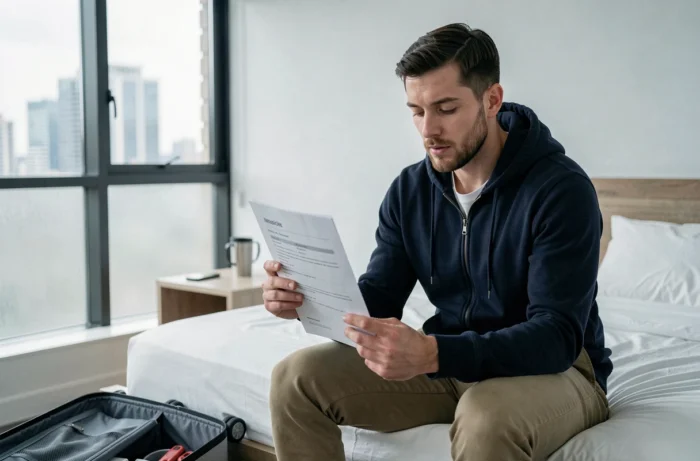
We observe frequent confusion between platform protection and insurance coverage. AirCover applies to the accommodation and the host-traveler relationship. Travel insurance covers the traveler themselves: health, luggage, personal liability, cancellation for medical or professional reasons.
The two systems hardly overlap. They complement each other. A traveler booking an Airbnb stay without personal travel insurance exposes themselves to potentially heavy costs in the event of an accident, illness, or luggage theft, situations that AirCover never covers.
Concrete Case: Non-Compliant Accommodation and Health Issue
If a traveler discovers an unsanitary accommodation and develops an allergic reaction requiring medical consultation, AirCover may intervene for relocation or reimbursement of the stay. Medical expenses, however, fall solely under travel insurance or the traveler’s social coverage.
The overlap of the two protections is not a luxury for long stays or remote destinations. Checking the limits and exclusions of each system before departure remains the only reliable approach to avoid administrative dead ends once on-site.