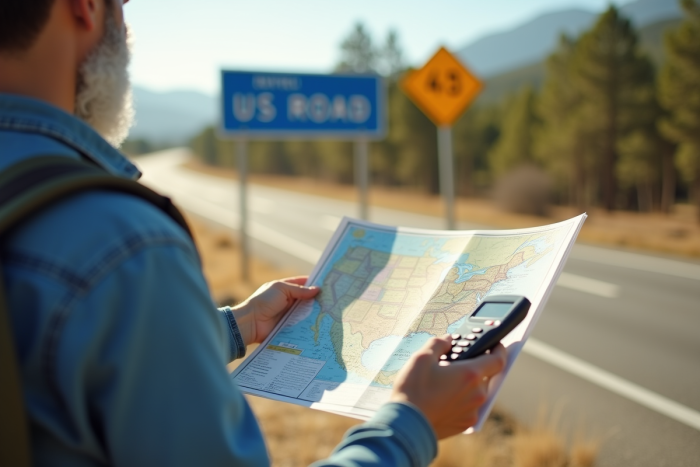
A mile does not equal 1.5 kilometers, but exactly 1.609344 kilometers. The confusion persists, fueled by the everyday use of approximate conversions and hasty rounding. On American road signs, distances stretch or shrink to the eye of the traveler accustomed to the metric system.
The official conversion factor, 1.609344, does not appear on any smartphone quick access and is not found on any tourist map. Yet, a conversion error can disrupt an itinerary, skew a time estimate, or lead to inappropriate logistical choices.
Why the difference between miles and kilometers can quickly complicate your trip to the United States
On American roads, the imperial system imposes its own codes. Signs indicate distances in miles, while rental car speedometers display values in mph, never in km/h. For a French traveler, accustomed to the metric system, each leg requires a conversion effort, a constant readjustment. It’s impossible to settle for a rough calculation: 1 mile in kilometers does not simplify to 1.5. It is 1.609344, as the page Conversion of miles to kilometers: tips and practical advice – Vacanceo reminds us.
The error sneaks in discreetly during planning. A journey of 200 miles seems manageable, but it represents over 320 kilometers. This difference is not trivial: it influences time management, selection of stops, or the pace of the day. If the GPS is not set to display the American unit, discrepancies arise. Sometimes one finds themselves redoing an entire itinerary or misjudging a fuel stop. On the road, these approximations can quickly become a real headache, especially regarding road safety. Missing a speed limit expressed in mph exposes you to a check, or even a fine.
Travelers opting for a camper van or a rental car often cross vast national parks. Distances stretch as soon as you leave urban centers. A small conversion error, seemingly harmless at first, gradually amplifies the itinerary by dozens of kilometers. The confusion between mph and km/h arises at the slightest lapse. To limit unpleasant surprises, always set your GPS, stay alert to signage, and keep a conversion chart or a reliable app handy. These adjustments add flavor to the journey in the United States and ensure smoother trips.

Concrete tips for easily converting miles to kilometers, even without a calculator
On the American road network, converting miles to kilometers quickly becomes an essential reflex. However, multiplying each distance by 1.609344 is not obvious in the heat of the moment. When deciding on an exit ramp, estimating if there is enough gas left, or adjusting speed, it’s better to have simple methods to apply.
Here are some proven techniques that make life on the road easier:
- Adopt the “rounded percentage” method: multiply the number of miles by 1.6. This trick allows for a quick, reliable estimate, largely sufficient for most trips. For example, 50 miles gives about 80 kilometers, 100 miles equals 160 kilometers. On a typical leg, the difference from the exact value remains minimal.
- Keep a conversion chart (printed or saved on your phone) handy. These visual references, easy to find on specialized sites, prove invaluable for preparing a route or checking the distance to the next national park.
- Set your GPS to display distances in kilometers when possible. This way, progress is shown in the unit you are familiar with, limiting approximations and errors.
For speed limits, a quick mental calculation simplifies the conversion: double the value displayed in mph, then subtract 20%. Thus, 60 mph corresponds to about 100 km/h. This rule has proven effective for many travelers and allows for stress-free driving during a trip to the United States.
Staying attentive to these subtleties offers a smoother journey, free from unpleasant surprises and unexpectedly long days. The American road awaits your vigilance and curiosity, to turn every mile into a memory, without ever losing track of the actual distances.